
Yin Yoga supports self-connection by creating the conditions for sustained self-observation. Through long-held postures and minimal external stimulation, the practice invites us to notice sensation, thought patterns, and emotional responses as they arise, without the need to act on or correct them. Over time, this non-judgmental awareness reveals how habits of tension, reaction, and choice are shaped in the body. Rather than striving for change, Yin encourages a relationship of listening and responsiveness. This capacity for presence supports self-acceptance as a lived experience, one that naturally extends into clearer boundaries, more conscious relationships, and a steadier sense of inner ease.
Self-acceptance begins with recognizing what is already present. Fatigue, frustration, stress, and moments of limitation are not obstacles to practice but information about the body and nervous system. When these experiences are acknowledged rather than ignored or judged, choice becomes possible. This awareness allows us to respond with appropriate care, set realistic boundaries, and make decisions that support regulation and sustainability rather than depletion.


Self-acceptance shapes how we relate to others. When we are able to acknowledge our own limitations, contradictions, and less comfortable tendencies, we are less likely to project them outward. This shift allows us to meet others with greater patience and discernment, recognizing that challenge, reactivity, and vulnerability are shared human experiences rather than personal failures. What we encounter in others can often reflect aspects of ourselves that are still asking for attention or understanding.
As this capacity develops, self-acceptance naturally extends beyond the individual. It supports clearer communication, more honest boundaries, and relationships grounded in respect rather than expectation. By letting go of the demand for perfection, both in ourselves and in others, we create space for cooperation, repair, and genuine connection. In this way, self-acceptance becomes a relational skill, shaping how we participate in the wider human experience with steadiness and care.
Owning our experience and meeting it with honesty and care is one of the most courageous acts we can practice.
As Brené Brown notes, “Owning our story and loving ourselves through that process is the bravest thing that we will ever do.” This perspective highlights that self-acceptance is not passive or indulgent, but a courageous willingness to meet our experience honestly, including discomfort, vulnerability, and limitation. When we stop resisting these aspects, self-compassion becomes practical rather than idealised, and authenticity naturally deepens both our inner life and our relationships with others.
The Yin Yoga practice creates conditions that support this kind of acceptance. Through sustained postures and minimal external stimulation, we gently stress the deeper connective tissues while allowing space for reflection and self-observation. Rather than seeking to fix or change what arises, Yin invites us to remain present with sensation, thought, and emotion as they are. Over time, this quiet attentiveness fosters a steady, embodied form of self-acceptance grounded in awareness rather than self-judgment.
Deepening the Yin Yoga Practice Through Study, Stillness, and Skilled Teaching
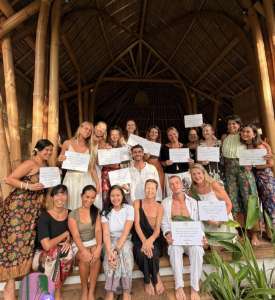
Our Yin Yoga Teacher Trainings in Nusa Lembongan, Bali, are designed for practitioners and teachers seeking depth, precision, and embodied understanding that extends well beyond foundational study. Offered through our 200-hour Accredited Vinyasa and Yin Yoga Teacher Training, as well as our 100-hour and 50-hour Yin Yoga formats, these trainings explore Yin Yoga as a complete and intelligent practice. Study integrates fascia, nervous system awareness, functional anatomy, and the principles of Chinese Medicine, including meridian theory, into a coherent and practical framework.